Robyn Exton, Mook Phanpinit, Jill O'Sullivan
Robyn is the CEO & Founder of HER. Find her on Twitter.
Select your language


Robyn Exton, Mook Phanpinit, Jill O'Sullivan
Feb 27, 2026
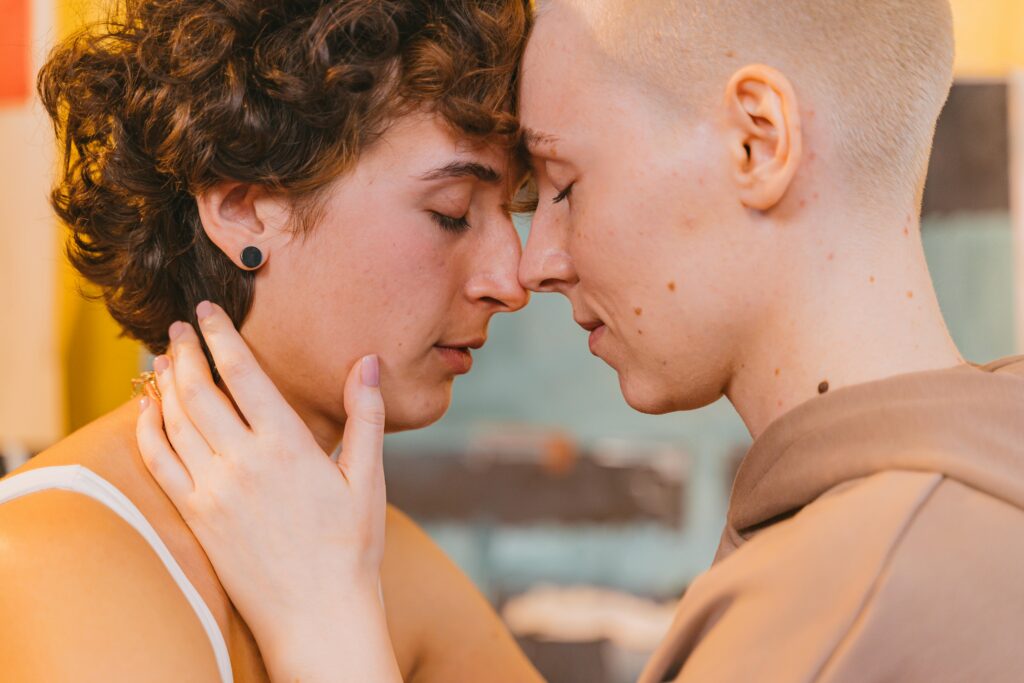
Let’s be real: the same tired myths about dating bisexual women keep resurfacing on apps, in group chats, and across sapphic TikTok. It’s overdue for a cleanup. Debunking these stereotypes matters because it builds trust, protects queer joy, and makes room for real connection with no policing, no gatekeeping.
Bisexual folks are the largest group under the LGBTQIA+ umbrella, with 57% identifying as bi in the U.S., making accuracy and support completely non-negotiable (see the HER x Hypebae myth-busting feature). On HER, we center self-identification and clear communication so you can find your people at your own pace.
Here’s the quick myth lineup we’re tearing down:
The “attention-seeking” trope pops up when people confuse identity with performance.
Performative bisexuality refers to someone pretending to be bi, often to gain social approval in certain settings, without genuine attraction or alignment. That’s different from a real bisexual identity, which is about authentic patterns of attraction, not optics or clout.
Most bisexual women’s attractions are exactly that: real. Dismissing them as performative erases lived experience and fuels the stigma that bi folks push back on every day (see this Goodfeed myth explainer). On HER, we hear countless stories from bi women navigating love, dating, and friendship with intention, not performance. If you’re new to the language, start with a primer on what bisexual means to anchor the conversation in facts, not vibes.
This myth assumes bisexual women are always hunting for “other options,” especially men, like loyalty is a math problem. It’s not. Commitment is about the person and the relationship, not the number of genders someone is attracted to.
Evidence and lived experience show that bi women form stable, lasting queer relationships; attraction to more than one gender doesn’t predetermine behavior (see this Voice of Salam misconceptions guide). If dating anxiety is knocking, talk about needs and boundaries early, because clarity beats guesswork 100% of the time.
| Myth assumption | What actually matters in healthy relationships |
| “More options = more likely to leave” | Shared values, communication, and mutual investment predict stability |
| “Men are the ‘default’” | There is no default—partners choose each other, not a gender category |
| “Bi = inevitable drift” | Relationship outcomes hinge on compatibility and effort, not orientation |
For more context, see the HER x Hypebae myth-busting feature on long-term queer relationships featuring bisexual women.
Sexual orientation isn’t a personality type or a bedroom forecast. Promiscuity simply means having many sexual partners. It’s a personal behavior that varies wildly across people and phases of life, and it isn’t dictated by orientation. Straight dudes and lesbians can be promiscuous too, and bi women aren’t statistically more likely to be. Plenty of bisexual women prefer monogamy, slow-burn dating, or no sex at all. Some others explore casually… just like literally anyone else.
Dating a bi woman is not an automatic ticket to threesomes or “wild” scenarios. Desire and boundaries are human things, not bisexual things (see Goodfeed’s myth breakdown).
| Myth | Fact |
| “Bi = always down for group sex” | Interest in threesomes is about personal preference and consent, not identity |
| “Bi = inherently more sexual” | Libido and behavior vary person to person across all orientations |
| “Labels predict bedroom choices” | Only direct, respectful conversation does |
You’ll hear this one from people who confuse capacity for attraction with capacity for commitment. Monogamy is a mutual agreement to have one romantic or sexual partner at a time, with boundaries that partners set together. It’s a relationship structure: never a personality diagnosis or an orientation test.
Research and community reporting consistently show bisexual people want all kinds of relationship structures from monogamous, non-monogamous, and everything in between at rates comparable to others (see Voice of Salam’s roundup of everyday misconceptions).
Commitment in bisexual relationships looks exactly like commitment anywhere else: clear agreements, follow-through, and repair when needed. On HER, you can share your boundaries and relationship goals upfront so matches know where you stand.
The idea that bi women are “a threat” to every friend group is not just wrong; it’s isolating and insulting. Respect, boundaries, and platonic connection exist regardless of attraction. Being bisexual doesn’t erase the ability to be a good friend, colleague, or community member (reinforced in the Goodfeed myth explainer). And like…. We shouldn’t have to tell you that.
Different relationships, different lanes:
If labels or settings feel ambiguous, spell them out. Use HER’s profile fields and filters to show whether you’re here to date, make friends, or both. Then, name your boundaries early.
Ah! That’s thebiphobia and erasure talking. Bisexual erasure is the widespread habit of dismissing or invalidating bisexual identities, especially when someone is dating a different-gender partner. Identity isn’t a switch that flips based on who you’re seen with; it lives in how you understand and describe yourself.
HER counters that gatekeeping by letting you customize your profile, prompts and Pride Pins so your identity is visible on your terms (see the HER app site). Staff and community stories from HER echo it too: partner gender doesn’t decide whether you’re queer (see Voice of Salam’s misconceptions guide). For a deeper dive into how erasure shows up and how to push back, read bisexual erasure is real.
No 50/50 scoreboard required. Bisexuality describes attraction to more than one gender, not necessarily at the same time, in the same way, or to the same degree (see The Trevor Project on bisexuality). Some bi women date women more often. Some date across genders evenly. Some have long dry spells, then meet one person who flips the universe. All of them are equally bisexual and equally valid.
You don’t need to ask for a ratio. Believe people when they share how they identify, and let the relationship unfold from there.
Orientation isn’t a resume. You don’t need past partners as “proof” to be recognized as bi. You’re not any less queer just because you haven’t touched or dated a woman before.
Self-identification means people name their own identity based on their feelings, experiences, and understanding of themselves. Both lived attraction and internal knowledge are valid, even without specific history (reinforced in Voice of Salam’s myth-busting).
If you’re dating, keep things simple: ask about preferences, not “receipts.” Share your own boundaries and pacing, too. Want a primer on language? Start with our guide to queer healthy relationships.
No. Bisexuality is a valid, stable orientation. Attraction can be fluid over time without being “just a phase.”
No. Bisexuality is about potential attraction to more than one gender, not current partner gender.
No, people can be attracted to different genders in different ways or at different times and are still bi.
No, cheating and indecision aren’t orientation traits. Relationship behavior comes down to agreements and character.
Believe their identity, listen without judgment, and communicate openly about needs and boundaries.
Looking to ground yourself in definitions and community perspectives? Try what bisexual means, bisexual erasure is real, and our guide to queer healthy relationships. For myth-busting context and stats, see the HER x Hypebae myth-busting feature, the Goodfeed myth explainer, and Voice of Salam’s misconceptions guide.
Bisexual Awareness Week: 6 Common Myths HER Wants To Debunk
6 Myths About Dating Bisexuals That Need to Be Busted
You’re Bi, So…? – 7 Everyday Misconceptions About Being Bisexual
Robyn Exton, Mook Phanpinit, Jill O'Sullivan
Robyn is the CEO & Founder of HER. Find her on Twitter.